
by: dr. Livia
Why Is the Brain Difficult to Treat?
Parkinson’s disease (PD) is a neurological disorder characterized by damage to brain cells that produce an important chemical called dopamine. This damage causes symptoms such as tremors, stiffness, and difficulty moving.
Unfortunately, the treatment of neurological diseases is often hindered by the Blood-Brain Barrier (BBB). The BBB is a natural protective barrier surrounding the brain. Its function is to prevent harmful substances from entering. Unfortunately, this barrier also prevents most conventional drugs from reaching the diseased areas of the brain where neurons (nerve cells) need help.
This challenge has prompted researchers to turn to a drug delivery method that can slip past this barrier: exosomes.
Exosomes: Natural Message Carriers
Exosomes are tiny bubbles or vesicles (measuring 30 to 150 nanometers—about one millionth of a meter) produced by almost all types of cells in the body.
Initially considered cellular waste, exosomes are now known to be vital couriers in intercellular communication. They carry “cargo” or messages in the form of bioactive molecules, such as:
1. Proteins: Molecules that help repair or perform cell functions.
2. miRNA (microRNA): Small pieces of genetic code that can give new instructions to recipient cells, such as “stop inflammation” or “increase endurance.”
It is this cargo that allows exosomes to influence the function of other cells, such as reducing inflammation or promoting repair.
Exosomes: The Key to Penetrating the BBB Fortress
The uniqueness of exosomes lies in their natural ability to cross the Blood-Brain Barrier (BBB). Because exosomes originate from the body’s own cells, the immune system does not see them as a threat. They can move through this defensive barrier, carrying therapeutic cargo directly to nerve cells in the brain.
The most promising exosomes often come from Mesenchymal Stem Cells (MSCs), as exosomes from these cells are rich in anti-inflammatory and nerve-healing cargo.
Strategies Targeting Parkinson’s
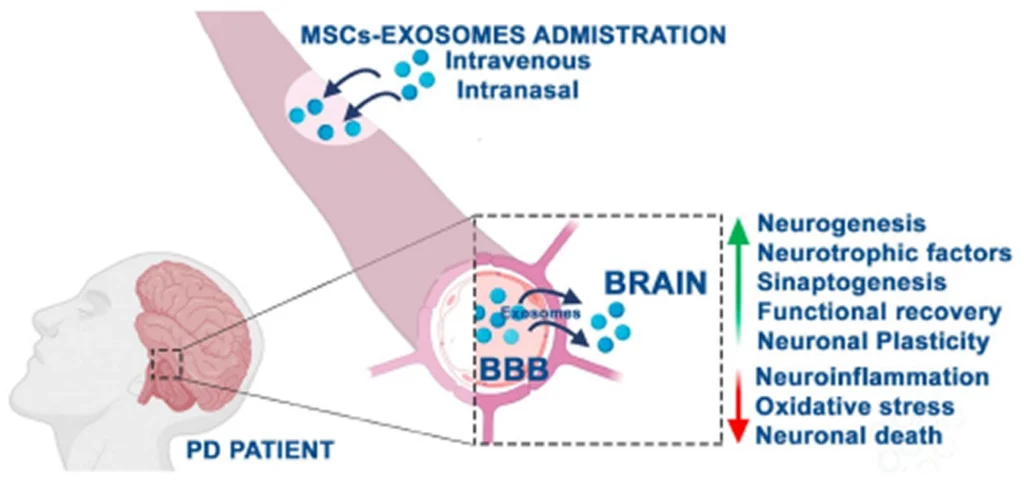
The therapeutic potential of exosomes in Parkinson’s patients based on several research models.1
Once exosomes successfully enter the brain and reach neurons damaged by Parkinson’s, they release their cargo to:
∙ Fight Nerve Inflammation: Exosomes carry miRNAs and proteins that can shut down the inflammatory pathways that damage nerve cells in the brain (called neuroinflammation).
∙ Enhancing Cell Resilience: The cargo carried by exosomes helps the remaining dopaminergic cells survive longer and fight oxidative stress (cell rust).
∙ Supporting Repair: They deliver healing factors that support neuronal health and potentially slow disease progression.
The Future of Therapy
Exosomes offer a solution to one of the biggest challenges in treating neurological diseases: effective drug delivery. With their ability to cross the BBB and carry specific therapeutic cargo—whether proteins, genes, or conventional drugs—exosome-based technology opens new avenues for more precise and non-invasive treatments for Parkinson’s disease.
Current research is focused on optimizing techniques for loading cargo into exosomes and modifying their surfaces to more specifically target diseased neurons.
References
1. D’Angelo, M., Cimini, A., & Castelli, V. (2020). Insights into the Effects of Mesenchymal Stem Cell-Derived Secretome in Parkinson’s Disease. International Journal of Molecular Sciences, 21(15), 5241.
2. Serrano, D. R., et al. (2022). Exosome-Based Drug Delivery: Translation from Bench to Clinic. Bioengineering, 9(8), 384. (In accordance with PMC9399222 discussion).
3. Zheng, R., & Wu, X. (2024). The potential of mesenchymal stem cell-derived exosomes as a therapy for Parkinson’s disease. Frontiers in Cell and Developmental Biology, 12. (In accordance with the discussion in Frontiers 10.3389/fcell.2024.1378393).